A$AP Rocky has been polishing some of his scratched PS1 discs and booting up some bootlegs.
So far for Rocky’s rollout for “Don’t Be Dumb”, we’ve been blessed with a Grand Theft Auto and PaRappa The Rapper spin off on his single cover art for Helicopter and Punky Rocky respectively. The connection between Rocky and GTA is clear (cue the “we got A$AP Rocky’s helicopter before GTA 6” jokes). But PaRappa The Rapper is a more subtle move. A cult classic that runs deep in the hip hop world, but doesn’t quite get granny all flustered like GTA does.
So what’s the significance behind PaRappa?
PaRappa Was a Music Game Before “Music Games” Had a Language
In the mid-90s — around the time A$AP was probably playing his first video games — the idea of console music was mostly about background detail. But as hip hop was really taking global shape, especially in countries like Japan, something new was cooking. Masaya Matsuura (a Japanese hip hop producer turned game-maker) came up with a concept that was deceptively radical at the time: turn sampling in hip hop into an actual game.
Matsuura was fascinated by the culture of sampling in hip-hop, something that was being revolutionised by the likes of DJ Premier, Q-Tip and Pete Rock just to name a few. It was likely influencing A$AP around the same time it was influencing Matsuura - one saw a rap career, the other saw a rap video game.
Hip hop was already teaching the world how to chop, loop, repeat, remix, respond. Matsuura essentially asked: what if the controller could do that too?
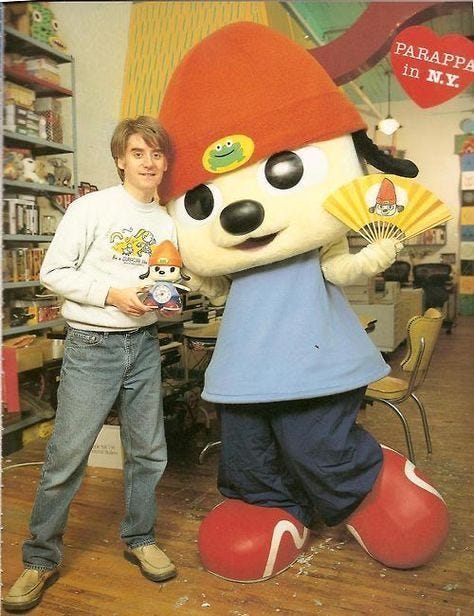
PaRappa the Rapper is a rhythm game about an anxious, big-hearted pup in an orange beanie who’s trying to level up in life the only way he knows how: by rapping through it. Across a series of absurd, everyday challenges, like learning karate, baking a cake, and driving, PaRappa trades lines with eccentric “teachers” (like Chop Chop Master Onion) in call-and-response battles, and you have to match their rhythm and cadence to keep the song going. It turned the PS1 controller into an Akai MPC of sorts (the beacon of sampling culture in hip hop).
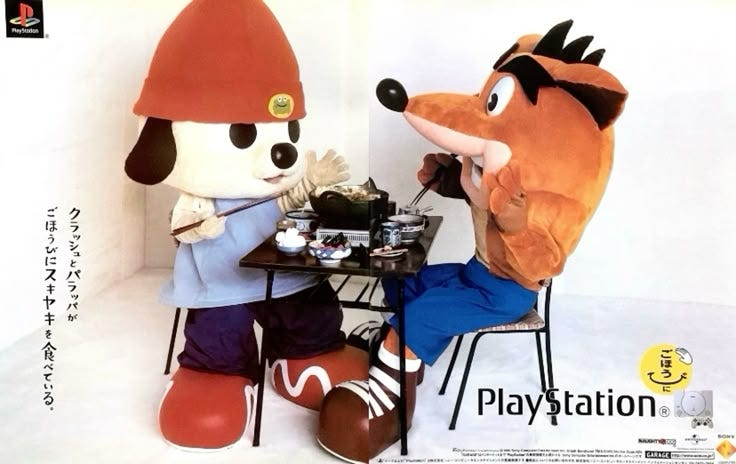
The PS1 as a Beat Machine (and Why Hip Hop Noticed)
This is where PaRappa becomes more than a cult nostalgia play from A$AP Rocky - the game helped normalise the idea that games could be music tools, not just music containers. Consoles were getting more sophisticated - why couldn’t the next era of producers start on a PlayStation instead of a Roland 808?
You can draw a line from PaRappa’s playful performance loop to later “sampler-style” console creativity, including Music 200/MTV’s Music Generator on PS1.
That matters because those games weren’t just for messing around. They became entry points. Bedroom studios before bedroom studios were a cliché. The kind of software that taught people how to build patterns, structure loops, and think in bars from the familiarity of a PlayStation controller. For a lot of future artists and producers, that was the first moment the screen stopped being a place to watch and became a place to make.
Artists like Skepta, JME, Dizzie Rascal and Big KRIT have all attested to using Music 2000/MTV Music Generator in their early careers to make their first beats.
Why Rocky’s PaRappa Reference Hits Harder Than GTA
GTA reinstates A$AP’s perennial dominance in the mainstream conversation. PaRappa says he’s fluent in the subtext. It’s a deeper cut that signals lineage, not necessarily fandom. It points to the part of gaming culture that didn’t just entertain hip hop, it quietly helped build it: the idea that a controller could turn into a sampler, a console could become a beat machine, that rhythm could be learned through muscle memory, that “making” could start in your bedroom with a controller.
A$AP is tipping his hat to a foundational idea in hip hop: that the tools change, the interface changes, but the mindset stays the same. Chop it up. Make it yours. Always keep them guessing.