

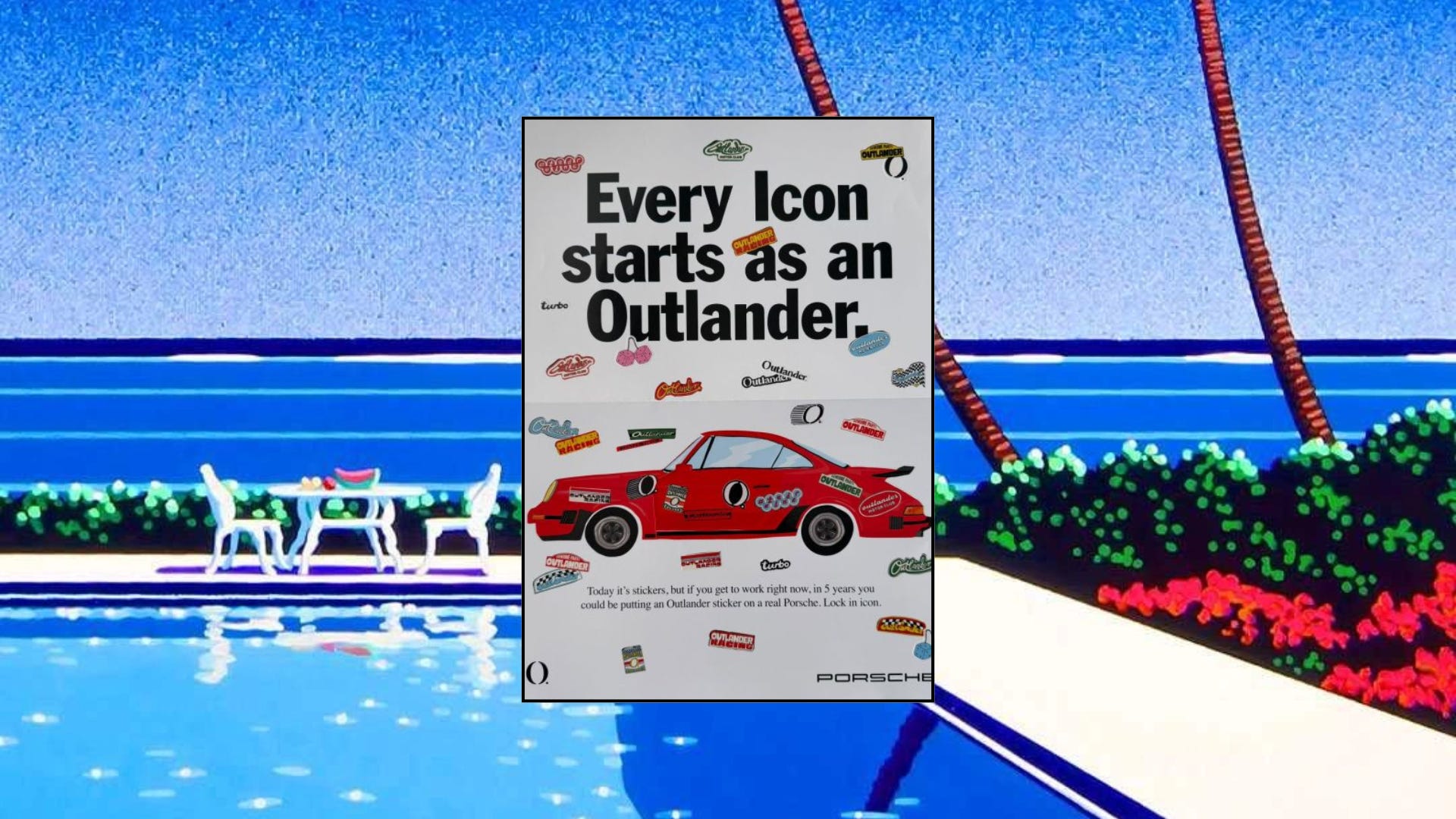
This article originally appears in Outlander Magazine ISSUE 02. We’ve spoken with leaders from Epic Games (Fortnite), Riot Games (League of Legends) and Maverick Games (Clutch) on Porsche’s pole position in gaming. Enjoy!
—
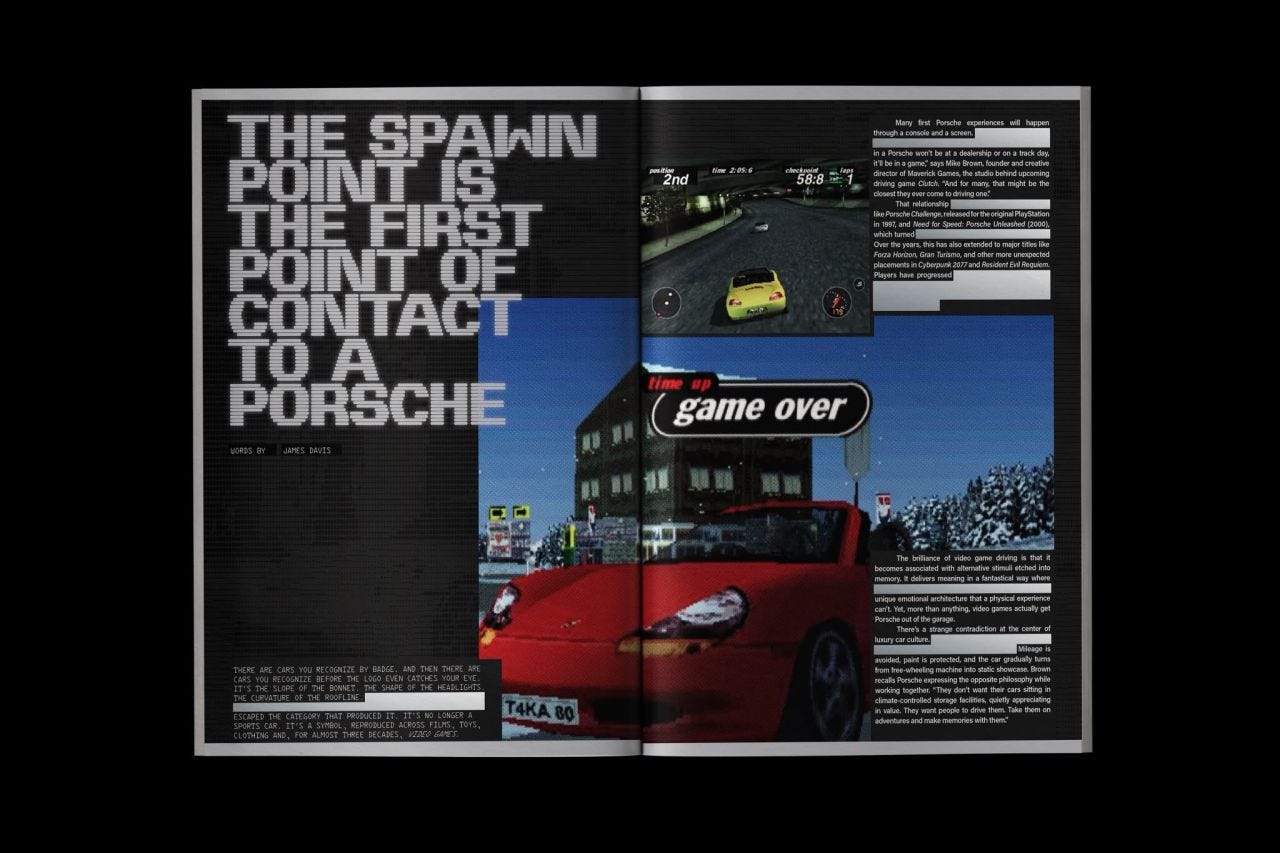
There are cars you recognise by their badge. And then there are cars you recognise before the glint of the logo even catches your eye. It’s the slope of the bonnet. The shape of the headlights. The curvature of the roofline. Much of the Porsche fleet belongs to a small group of objects whose silhouette has escaped the category that produced it. It is no longer simply a sports car. It is a symbol, reproduced across posters, films, toys, clothing and, for almost three decades, video games.
For many people, the first Porsche they drive will not be real. It will not involve a dealership, a track day or a giant felt bow. It will happen through a controller.
“For a lot of people, and this was certainly true for me, the first time they’ll ever sit in a Porsche won’t be at a dealership or on a track day, it’ll be in a game,” says Mike Brown, founder and creative director of Maverick Games, the studio behind upcoming driving game Clutch. “And for many, that might be the closest they ever come to driving one.”
That relationship stretches back through games like Porsche Challenge, released for the original PlayStation in 1997, and Need for Speed: Porsche Unleashed (2000), which turned the brand’s history into a playable timeline. Over the years, this has also stemmed to major racing titles like Forza Horizon, Gran Turismo and other unexpected placements in Cyberpunk 2077 and Resident Evil Requiem. Players have progressed through decades of Porsche design, effectively learning the brand through acceleration, oversteer and slippery cornering via a pair of Cheeto-dusted joysticks. At least it never got on the seat leather.
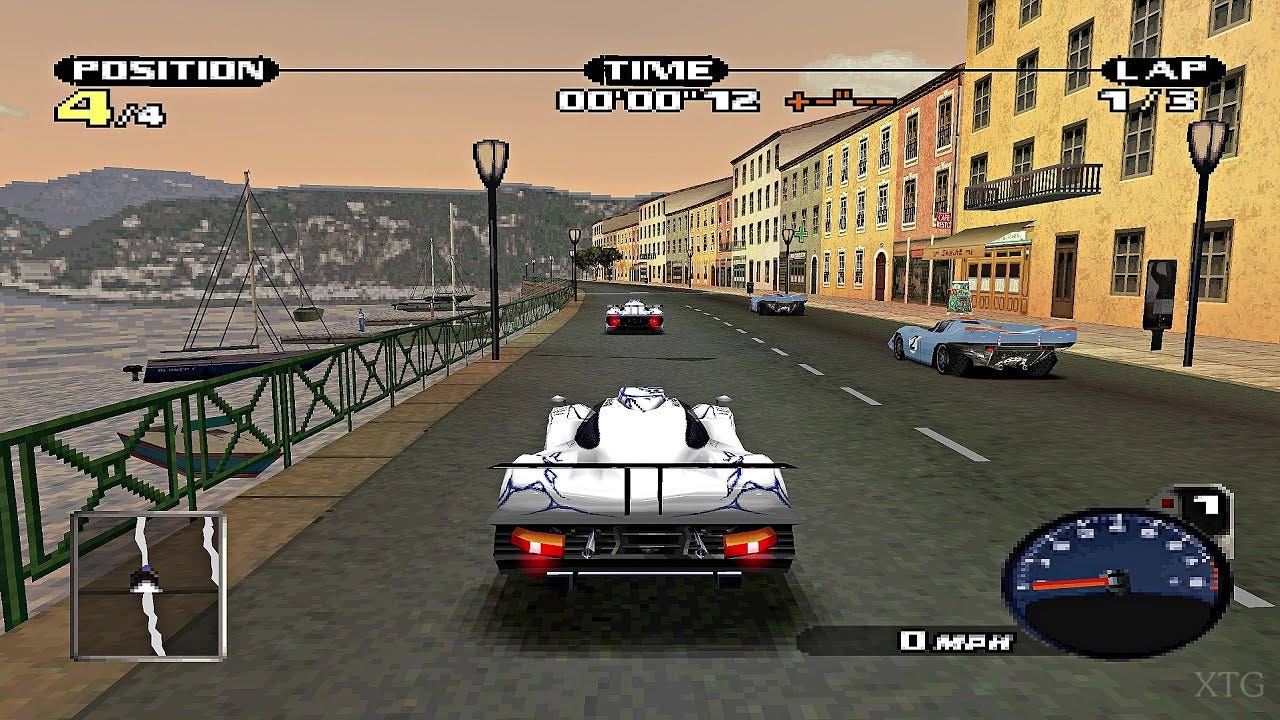
The brilliance of driving in video games is that it becomes associated with alternative stimuli. Spirited chats with multiplayer squads. Missions that kept you up until 2:47AM. Achievement unlocks that you’ll never forget. The in-game drive delivers meaning in a fantastical way. Games may not provide ownership, but they can provide a unique emotional architecture that a physical experience can’t.
Yet, more than anything, video games actually get Porsche out of the garage.
An Icon Isn’t Meant To Stay Parked
There is a strange contradiction at the centre of luxury car culture. The more desirable a vehicle becomes, the greater the temptation to preserve it. Mileage is avoided. Paint is protected. The car gradually turns from free-wheeling machine into static garage showcase.
Brown recalls Porsche expressing the opposite philosophy while working with Maverick Games. “They don’t want their cars sitting in climate-controlled storage facilities, quietly appreciating in value. They want people to drive them. To take them on adventures. To make memories with them.”
Games take this belief to its logical extreme. A virtual Porsche cannot become too valuable to use. It can be raced, modified, damaged, restarted and pushed far beyond the limits of sensible ownership. Its cultural value increases through mileage gained rather than features preserved.
As the car is pushed to limits it may never face in real life, the accuracy of the driving experience is paramount. Maverick Games has spent three years developing the vehicle physics simulation for Porsche in Clutch, feeding in real-world information such as wheelbase, weight, acceleration and top speed. But Brown argues that data only establishes the foundations.
“The really interesting part is recreating the soul and personality of the car,” he says. Developers eventually stop talking about numbers and start using words such as “intuitive, connected, planted, fluid and trustworthy.”
“You can’t measure them with a spreadsheet, but anyone who’s driven a great Porsche knows exactly what they mean.”
This is where the digital Porsche becomes more than a replica. Players arrive with an idea of how the car should feel from everything they’ve consumed around the legacy, even if they have never actually touched one. The icon has already formed in their imagination. The game must make that imaginary version convincing.
Porsche has even designed directly for this space. Created for Gran Turismo 7, the Porsche Vision Gran Turismo was the company’s first concept study developed specifically for a game. Rather than gaming reproducing an existing Porsche, Porsche used gaming to imagine one that did not yet exist.
By building future icons in gaming environments a vehicle is no longer locked to one kind of road or track – it could fly through space, speed through water or even score your next goal in Rocket League.
The Icon Takes The Side Quest
In traditional racing games, Porsche is still principally a vehicle. In Fortnite and League of Legends: Wild Rift, it begins behaving more like fashion, performance and character design.
Kevin Durkin, Senior Director of Partnerships Strategy at Epic Games, describes Fortnite as a place where accuracy provides the foundation, but player behaviour completes the idea.
“We work closely with Porsche to ensure that we’re accurately bringing their cars to life in-game,” he says. “Once the cars are in our players’ hands, that’s where the fun and fantasy comes to life. Only in Fortnite can you drive a Porsche as your favourite superhero.”
Here, the car becomes part of how someone arrives, escapes or expresses themselves. It offers no competitive advantage. Its function is partly symbolic, partly fantasised.
But don’t mistake this for inaccuracy. Durkin points to a member of the Fortnite community who maintains a database of the game’s vehicles and posted about the accuracy of the Cayenne Turbo Electric’s engine sounds. Even within a world of superheroes and flying battle buses, players still listen for whether the Porsche sounds right.
The collaboration also escaped the game itself. Porsche’s configurator allowed users to customise the Cayenne Turbo Electric inside a Fortnite environment, watching fireworks and the Battle Bus through the window of your own car. The car configurator had become a playable space, part showroom and part Easter egg.
In League of Legends: Wild Rift, Porsche moved further away from simply representing a car. Riot Games paired the 911 GT3 with Kai’Sa, a champion defined by speed, precision and adaptability. Her abilities, animations and sci-fi armour absorbed Porsche’s design language.
The team’s guiding principle was not to “slap a logo into the game,” according to Riot Games. Instead, Porsche elements appeared throughout a racing-themed visual update, the Neon Daredevils skin line and an altered game mode that sent players racing out of their base in cars.
Kai’Sa’s recall and “Killer Instinct” animations featured Porsche vehicles, making the brand feel like “a natural extension of her in-game power and agility,” according to Riot. The 911 was no longer merely transport. It had become a character trait.
Riot later brought that fiction back into reality through custom Wild Rift Porsche 911 GT3s at events in Shanghai and Los Angeles. Creators drove the cars and played the game at Porsche’s facilities. One reportedly described it as the “best day of their life, says Riot. A bold claim, perhaps, but riding in a Porsche designed with Kai’Sa as muse is detained to encourage a little melodrama.
Most players will never own a Porsche. Yet they may still remember the first one they “accidentally” drove into the guardrails on Gran Turismo, or through the shady streets of Resident Evil Requiem while escaping a mutated zombie onslaught.
Porsche’s gaming story is not simply about product placement. It is about an automotive icon learning how to exist in spaces where cars are not adhering to typical physics or standard methods of driving. Nor are they staying locked in climate controlled garages.
Instead, they are driven, remixed, worn and occasionally launched off the side of a mountain.